Beyond Early Access: What Pre-Release Really Means
All providers, big or small, have some sort of promotional tool available — and the bigger the name, the bigger the budgets, the vaster the diversity of tools presented.
One of those tools is the ability to give a partner content before anyone else gets it: a pre-release.
What it actually is
It's worth separating this from exclusivity outright.
An exclusive game stays with one operator, sometimes for good. A pre-release doesn't: the game still reaches the wider market, one partner just gets there first, for a set window.
Why it holds up commercially
That distinction is also why the model holds up commercially. A temporary head start carries far less risk than locking a title to one operator:
-
No long-term exclusivity commitment
-
No removing the game from the broader roadmap
-
Nothing to unwind if the partnership shifts down the line
It's a lever gambling software developers can pull often, not a one-off bet.
That's part of why it's become a common approach in the U.S. market in particular: Casino.us editor Max Brimmer, in an interview with Gambling911, has noted that timed early access is the most common form of exclusivity there, precisely because it's low-risk and regulator-friendly.
It's not random, either
The choice of which titles get this treatment doesn't have to be random. Performance data from earlier releases — which mechanics held attention, which volatility profiles kept players in a session — can inform which upcoming game is worth giving a partner early.
That turns pre-release from a scheduling favor into part of the product roadmap.
What's in it for the provider
Sometimes it's straightforward monetization — better commercial terms tied to the exclusivity period. Other times it's more of a trade: a strong promotional push from the operator, prime placement, a dedicated campaign around the launch, in exchange for the head start rather than for direct payment.
Which one applies usually comes down to the release itself and the provider's read on the partner — a flagship title going to a top-tier operator is a different conversation than a smaller release going out to reward a smaller partner
Why operators want it
For operators, the appeal is straightforward: something no one else has yet. That's useful for a CRM push or a VIP outreach that needs a concrete reason to reach out this week, not a generic "new game" line.
It's also one of the few tangible advantages a provider can offer through a direct integration that an aggregator relationship typically can't match.
The visibility bonus
Websites that track upcoming slot releases - previews, launch dates, sometimes early demo access - routinely source that content from providers ahead of a game's official date.
That means a pre-release doesn't stay contained to a single commercial deal; it tends to surface as attention and coverage before the wider launch even happens.
A strategic choice
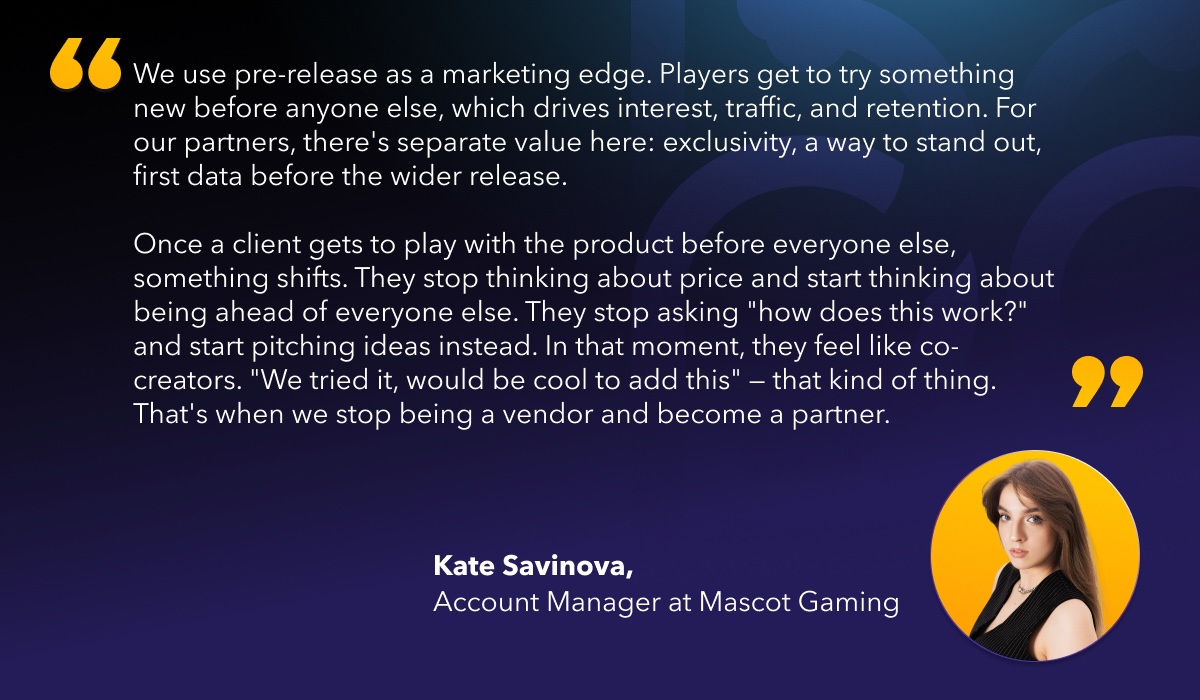
Handing over the early access is just the starting point. What turns it into an actual advantage — how it's packaged for players, how it's timed against other campaigns, whether it becomes a test before a wider push — rarely gets figured out by the operator alone. The providers who get this right stay close through that process: shaping the rollout together, treating an operator's ideas as part of the plan rather than feedback after the fact. That's what actually happens in the day-to-day conversations account managers have with their partners.